

 Italiano
Blog, Places to visit, Unusual itineraries
WHAT TO SEE IN TREVISO? OUR GUIDE TO DISCOVER VENICE GARDEN

Dec
What to see in Treviso? The complete guide with our suggestions for visiting Treviso and its surroundings.
Treviso, a city of art and water that pleasantly surprises those who enter its arcades, placid canals and splendid frescoed houses. In this complete guide we have collected our suggestions for visiting Treviso, discovering all its facets.
In this article:
- The classic destinations
- Mysteries and legends of Treviso
- In the footsteps of illustrious figures
- The locations of “Signore e Signori” movie
- Memories of Great War
- The historic shops
- Treviso mills
- Treviso fountains
- The most sumptuous villas and palaces
- The churches of Treviso among art and faith
- Other places to see in Treviso
WHAT TO DO IN TREVISO SURROUNDINGS
WHAT TO SEE IN TREVISO? HERE ARE SOME TIPS FOR VISITING TREVISO IN ONE OR MORE DAYS
CLASSIC ATTRACTIONS
Let’s start with the classic attractions of the city such as its centre, Piazza dei Signori, overlooked by Palazzo dei Trecento, Palazzo della Prefettura and the majestic Torre Civica. Nearby, at the crossroads between the cardo and the decumanus, stands the marvelous Loggia dei Cavalieri. Another place not to be missed is the Cathedral with its works of art but also the mighty walls whose doors constituted the triumphal entry into the capital of Marca.

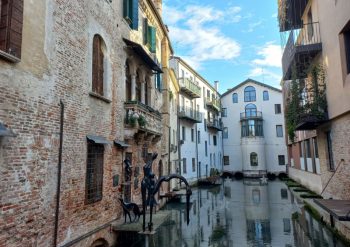


PIAZZA DEI SIGNORI
Piazza dei Signori, symbol of Treviso, constitutes the historical, cultural and social center of the city. This square was once called “della Berlina”.

This term refers to the ancient punishment, which was practiced here, consisting in exposing the condemned person in a public place wearing writings or symbols that described the type of crime committed in order to humiliate him.
Some majestic buildings frame the square: Palazzo dei Trecento, built in Romanesque style at the beginning of the 13th century, the ancient seat of Maggior Consiglio, Palazzo della Prefettura, built between 1874 and 1877, and the Palazzo del Podestà, in Lombard Renaissance style originally from 1491 but which underwent several renovations over the centuries.
Finally, the Civic Tower of medieval origin stands out imposingly with its forty-eight meters of height and houses the characteristic “Campanòn”. In fact, in the belfry there is a bell weighing approximately 2700 kilograms which is now hammered every hour. It is the third largest in the Region after Campana Granda of Padua and Rengo of Verona.
LOGGIA DEI CAVALIERI
It is one of the oldest civil monuments of Treviso, an emblem of the political power assumed by nobles and knights in the period of the Free Municipality. The building, in Treviso Romanesque style with Byzantine influences, was built in 1276 under the power of the podestà Andrea da Perugia as a place for conferences, conversations and games which, however, common folk could not access.
DUOMO
The Cathedral complex includes, in addition to the Church dedicated to St. Peter, the Baptistery, the Bishop’s Palace and the Rectories. Probably, for this reason the writer Giovanni Comisso defined it as “The little Vatican”.
Although the structure we see today, in neo-Renaissance style, mainly dates back to the reconstruction carried out in the 18th century, the Cathedral was originally built in the 11th-12th centuries (the Romanesque crypt was in fact built in 1030). The pronaos that characterizes the façade on the square with its majestic staircase dates back to 1836. If we raise our eyes, however, we see the seven domes that characterize the roofing of the naves. Inside, among the various works preserved, do not miss Tiziano’s “Annunciation”, a wonderful painting that the artist from Cadore created in the third decade of the 16th century.
THE MAJESTIC WALLS AND GATES
One way to visit Treviso by observing it from a singular point of view is to walk along its walls.

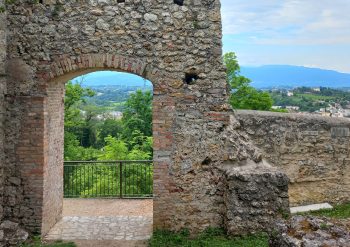
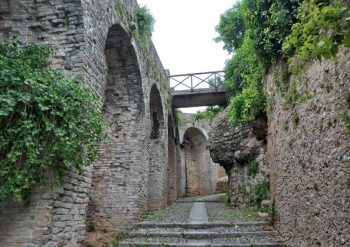
Even though there was already a city wall in Roman times, the current vestiges date back to the sixteenth century, when Fra’ Giocondo first and Bartolomeo D’Alviano then contributed to their strengthening and expansion on behalf of the Serenissima, creating the embankment covered by the thick wall of bricks still visible today.
Once the walls were built, the hydraulic works began: not only a water perimeter was built around the city, but also the possibility of flooding the surrounding plain, putting any attackers in difficulty.
Even today the city walls, interspersed with circular towers, with the half-hidden gunboats, testify to the important defensive role assumed by the city at the time of the Serenissima.
Interrupting the walls were the three wonderful gates that ensured entry to the city: Porta Altinia towards the South, Porta San Tomaso towards the North, Porta Santi Quaranta towards the West.
Near the main bastions such as Porta Altinia or the bastions of San Paolo we can still observe today, set in the brick facing, elegant bas-reliefs depicting the winged lion, symbol of the power of the Republic of Venice, to which Treviso was subjected in the 14th century.
MYSTERIES AND LEGENDS OF TREVISO
Why not discover the darkest and most evocative face of Treviso by visiting the places linked to curiosities, mysteries and legends of the city? Spirits of girls, damned souls, mysterious creatures still hover today among the churches, walls and oldest buildings.
For example, in Piazza del Duomo there was once the birthplace of the Da Romano family, one of the most powerful families in Veneto during the medieval era. Ezzelino was born right here and there are numerous legends concerning him: he was attributed the gifts of ubiquity and invulnerability, it is said that he was a heretical, diabolical and cruel being and that his conception occurred in very singular circumstances, even work of the devil.
The city was also the scene of numerous and sumptuous festivals, and for this very reason, Treviso area soon became the “joyful and loving Marca”. One of these celebrations took place in 1214 when it is said that a large Castle of Love was built, where a group of girls entered who had to “defend” it from the gallant assaults of three teams made up of Trevisos, Paduans and Venetians. Who do you think was the winner?
Another curiosity is linked to the patron saint of journalists, San Francesco di Sales. In fact, the Visitandine nuns of the city still today devoutly preserve his relics, which arrived here after the French Revolution.
IN THE FOOTSTEPS OF ILLUSTRIOUS PEOPLE
Another unusual way to discover Treviso is certainly to retrace the footsteps of the illustrious people who were born or frequented the city such as Tomaso da Modena, Giovanni Comisso, Daniele Manin and many others.
TOMASO DA MODENA
Tomaso da Modena, who lived in the heart of the 14th century, was a great innovator in the history of art: his works, almost all created in Treviso, are characterized by a sense of perspective and particularly expressive faces.
A curiosity is linked to this artist: the first image of glasses in the history of art is attributed to him. In the beautiful frescoes that adorn the Dominican Chapter room in the Church of San Nicolò, in 1352 Tomaso depicted Ugo di Provenza and Niccolò di Rouen, the former with glasses held tightly to his nose, the latter reading with the help of a magnifier.
An interesting itinerary that touches all the city places where his masterpieces are visible such as the Church of S. M. Maggiore, the Museum of S. Caterina, the Church of S. Francesco, the Church of S. Lucia, the Diocesan Museum and obviously the Church and Chapter of S. Nicolò.

DANTE ALIGHIERI
“E dove Sile e Cagnan s’accompagna, tal signoreggia e va con la testa alta, che già per lui carpir si fa la ragna”.
In the IX canto of Paradiso, Dante Alighieri, through the voice of Cunizza da Romano, sister of the famous tyrant Ezzelino, issued a warning to the main centers of Treviso area, marked by internal strife.
In May 1865, inspired by the words of the Supreme Poet, the municipality of Treviso wanted to dedicate a stele in his honor. The place chosen was precisely the point of confluence between the two rivers mentioned in the Divine Comedy, crossed by a small bridge which took the name of Ponte Dante.
A tribute from the city that hosted Dante and which, in the church of San Francesco, still preserves the tomb of his son Pietro today.
This bridge was also known as the “Bridge of the Impossible” because so many times, precisely at that point, attempts had been made to build a passage with walkways and wooden bridges but they had been swept away at the first flood of the river. It now seemed impossible that it could remain standing and instead the stone version managed to win the challenge.
Precisely on these banks once stood squeri, that is, the places where the boats were built and used for trade with Venice.

TREVISO OF ARTISTS, SAINTS AND HEROES
The capital of the Marca is linked to the name of numerous other artists, saints and heroes who were born, lived there or spent part of their existence in the city. Among these we remember the writer Giovanni Comisso, the painter Gino Rossi, the sculptor Arturo Martini but also saints and blesseds such as Suor Maria Bertilla, Beato Enrico da Bolzano and Pope Benedict XI. Not to forget the heroes of the Risorgimento such as Mazzini’s Luigi Pastro and Daniele Manin who held his secret meetings here.
THE LOCATIONS OF “SIGNORE E SIGNORI” MOVIE BY PIETRO GERMI
A singular and fun idea for visiting Treviso, in particular for cinema enthusiasts but not only, is to retrace the places that were the backdrop to some scenes of the famous movie “Ladies and Gentlemen”, one of the highest results of the comedy Italian style of the sixties. The director Pietro Germi, in his movie, summarizes the private vices of an entire middle-upper bourgeois class in Italy in 1965, in which hypocrisy, superficial respectability and getting away with crime on every occasion, before the law and before the precepts of the Catholic Church. In the exteriors of the film you can recognize Piazza dei Signori, via Calmaggiore, via San Nicolò, borgo Mazzini, via Roggia, via Sant’Agata, borgo Cavour, vicolo Avogari, riviera Santa Margherita, piazza Monte di Pietà and the railway station.
MEMORIES OF THE GREAT WAR IN TREVISO
Another interesting thread to follow for a visit to Treviso, especially from a historical point of view, is that of the Great War. An itinerary that allows you to relive the fears and fervor of a global event.
In 1905 Treviso became the largest military center in Northern Italy as the railway lines that took soldiers to the front passed here. Some places were equipped as field hospitals or refugee shelters and many buildings were seriously damaged.
For example, the Church of San Francesco and San Nicolò were used for military purposes, Porta San Tommaso will open upon the arrival of refugees, Ospedale dei Battuti will welcome numerous wounded. Subsequently the city will also host the high command and the Soldier’s House.
Nowadays the traces of the War are no longer visible but by following this itinerary it will be possible to relive those hard moments of battles and clashes fought with courage and dignity.
THE HISTORICAL SHOPS OF TREVISO
There are numerous historic shops in the center of Treviso, witnesses to the stories and passion of the people who have carried on the business over decades and sometimes centuries. So why not get to know this cross-section of city life?
This journey begins way back in 1398, when the oldest business, San Martino pharmacy, opened. Another historic workshop is Colorificio Vasconetto, inventor of “Treviso green”, an atypical and particular color of Treviso, which has been carrying on its business since 1856. We then find the Fanoli Pharmacy, opened by Austrian imperial decree in 1790, the Giraldo Jewelry shop, a point of reference for jewelery lovers since 1880, Ragazzoni, which has handed down the art of upholstery since 1890, the “Van Den Borre” nurseries which are sinking their roots date back to 1854, the year in which the founder Francesco Van Den Borre arrived in Italy from Ghent in Belgium. Finally, Danesin Gastronomia, whose story begins in the 1920s with first the cart and then the van of Luigi who went around the villages of the Treviso area bringing with him the product he was passionate about: Parmigiano Reggiano, a rarity for those times . An intriguing journey to rediscover the know-how, history and culture of this city.
 TREVISO MILLS
Napoleonic maps and historians confirm that the mills that stood at the end of the current Riva del Cagnan Comisso constituted the first nucleus of land on which the Island of Pescheria would later arise.
So, one point of view to discover the most hidden corners of Treviso could be to follow the waters that cross the city until reaching its mills such as the one on Cagnan Grando and Pescheria. Originally the mills were equipped with four wheels: one stood where the Gentj shirt factory now stands, the second and third probably inside the former Casa del Detersivo, a fourth close to the walls of the Muscoli’s tavern.
Precisely the processing waste, dumped into the basin of the current fish market, would have accumulated, forming islets which, consolidated, would have constituted the first island which would later host the fish market.
TREVISO FOUNTAINS
Treviso “che di chiare fontane tutte ride” wrote the Florentine poet Fazio degli Uberti. We can only agree. Some of the hidden treasures kept within the city walls are the fountains, some truly unique.
FONTANA DELLE TETTE
The most particular one in the city is certainly the “Fountain of Tits”, a few steps from Palazzo Pretorio. It depicts a woman with an exposed bust holding her breasts, from which two lively jets emerge. It was built in 1559 on the orders of Alvise Da Ponte, mayor of the Republic of Venice at the time following a severe drought that hit Treviso and the surrounding countryside. From that year until 1797, the year of the fall of the Serenissima, in honor of each new Podestà, red wine flowed from one breast and white wine from the other from the fountain and all citizens could drink for free for three days.
Today the recovered statue of the fountain is located in Ca’ da Noal but what attracts the curiosity of passers-by is a faithful replica, placed on the original site, created by the sculptor Miguel Miranda.
 TRE VISI FOUNTAIN
This singular three-sided fountain refers to the origins of the toponym Treviso (from Tervisus: tre vedute) and to the origins of the city, which arose from three primitive nuclei on the respective heights of Piazza dei Signori, Piazza Duomo and Sant’Andrea. The lower part consists of a basin into which the water pours from the mouths of four stylized lion heads.
PIAZZA SAN VITO FOUNTAIN
Already described as “beautiful and elegant” by the newspapers of the time, this fountain was offered by traders as a sign of gratitude towards the municipality of Treviso for having maintained the fruit and vegetable market that once took place there in the square. The marble artefact created in 1930 consists of an ornamental upper part and a small lower fountain originally intended for domestic use.
THE MOST SUMPTUOUS VILLAS AND PALACES
To learn about the glories of Treviso‘s past there is no better way than to discover the villas and palaces that dot the city. Here are some suggestions.
PALAZZO SCOTTI
The current Scotti palace was built to a design by Ottavio Scotti in the first half of the eighteenth century. A skilled architect representing Venetian classicism as well as the author of several works in Treviso such as the churches of Santo Stefano and Santa Croce dei Battuti, thanks to his project he reorganized the old family residences, of medieval origins. In the last century, during the last war, it hosted the command of the XIV Army Corps.
PALAZZO BOMBEN
This palace, which stands on ancient buildings dating back to the 14th-15th century, partly incorporated in the subsequent modifications that took place until the middle of the last century, today houses the headquarters of the Benetton Studies Research Foundation.
The origins of this building date back to 1280 when it was owned by De Castelli nobles, then it passed into the hands of the Tempesta family, advocates of the Bishop, and subsequently to the Carrara family. Finally, the Republic of Venice donated it to the Florentine Bombene (or Bomben), winner of the Carraresi.
In 1944 the rear part of the building was hit by a bombing which caused the collapse of the roof, the attics and part of the walls.

MONTE DI PIETÀ
It is one of the most interesting places in the city, especially from an artistic point of view. In the past, the role of this institution was to combat usurious lending by giving access to low-interest loans in exchange for objects left as collateral. Its origins date back to 1462, when the Franciscan Friars, with the aim of helping those most in need, decided to establish Monte di Pietà.
In 1496 it was Bishop Nicolò Franco supported by the Podestà Girolamo Orio and Provveditori, who ensured that the Municipality donated the building to be used as the headquarters of Monte di Pietà. During the 16th century, due to the lack of space in which to store goods, the building was expanded several times.
One of the most artistically interesting parts of the building is the Rectors’ Chapel decorated with frescoes on sacred subjects dating back to the second half of the sixteenth century. Among the noteworthy works is that of Ludovico Fiumicelli who created “The multiplication of the loaves and fishes”.
Monte di Pietà, active until around the middle of the 18th century, is today owned by the UniCredito Italiano Group.
VILLA MANFRIN
The building was built between 1775 and 1783 based on a design by the architect G. Antonio Selva. Inside, some rooms are decorated with stucco. The large barchesse frame a beautiful fishpond and preserve some interesting terracotta tiles.
CA’ ZENOBIO
The palace dating back to the end of the 16th century was remodeled during the 18th century. The central body has overlapping three-lancet windows, the second floor is created between columns and Ionic pillars. Barchessa built in the seventeenth century has a loggia with arches and key stone masks. The park is embellished by the presence of statues and centuries-old plants.
PALAZZO DOLFIN
The origins of the palace date back to the period between the 17th and 18th centuries. Built on behalf of Salvatore Orsetti, the palace is traditionally attributed to the architect Andrea Pagnossin, but is ascribed by others to the work of Ottavio Scotti or Antonio Gaspari. Towards the end of the eighteenth century it passed to the Venetian patrician Dolfin family but soon the ruin caused by the fall of the Republic in 1797 led to the transfer of ownership into the hands of Francesco Cestari.
CA’ SPINEDA
Property of the noble Spineda family until the mid-19th century, the building was built around 1560 at the behest of Gaspare Spineda.
Very interesting from an artistic point of view are the frescoes on the staircase attributed to Gaspare Diziani which depict a series of allegorical representations surrounded by stucco decorations: the four cardinal virtues, and four other female figures who personify Art, Military Glory, Abundance and one of unspecified meaning. From 1935 to today it has been the representative office of the Cassamarca Foundation.
THE CHURCHES OF TREVISO BETWEEN ART AND FAITH
SAN NICOLO’ CHURCH
The construction of San Nicolò Church began at the dawn of the 14th century by the Dominicans, taking advantage of the legacies that Pope Benedict had generously donated. The plague epidemic that hit Europe between 1348 and 1350 caused the work to be interrupted.
Once the wave of death passed, the painter Tomaso da Modena was commissioned to fresco the Chapter Hall of the Convent to pay homage to the order. Even today you can admire the wonderful portraits of the major representatives of Dominican glory. Precisely among these figures we can notice a bespectacled friar who with a curious gaze leafs through the pages of a book, probably the first representation of glasses in the history of art.
SAN FRANCESCO CHURCH
The structure of this church well represents the ideals of simplicity and essentiality so dear to the Franciscan order, particularly in the interiors, where the bare brick walls and the soft light create an environment of great balance and profound spirituality.
The building was built between 1230 and 1270 at the behest of Pope Innocent III, thanks also to the considerable donations from the municipality as well as those from the Treviso aristocracy.
The right nave houses the tomb of Francesca Petrarca, daughter of the well-known poet, who died in Treviso in 1384, while in the left nave there are frescoes by Tomaso da Modena and some students.
SANTA MARIA MAGGIORE CHURCH
Santa Maria Maggiore Church, also known as “Madona Granda”, dates back to the 8th century and stands where there was a capital with the image of the Virgin. The building, destroyed during the barbarian invasions, was rebuilt after the year 1000.
It was rebuilt again in late Gothic style in the second half of the fifteenth century by the Lateran Canons, keeping only the image of the Madonna unchanged, a work created by Tomaso da Modena.
A curiosity linked to this church: at the beginning of the sixteenth century part of the bricks that made it up were removed for the construction of the new walls.
SANTA LUCIA CHURCH
The building was built towards the middle of the fourteenth century in the place where Treviso prisons stood, devastated by a fire. The interiors, dimly lit with a low ceiling characterized by three cross vaults resting on six columns, are reminiscent of a crypt. The church was enlarged in 1389 to accommodate the cult of St. Lucia in memory of the return of Treviso to Venice after the removal of the Carraresi from the city.

SAN VITO CHURCH
This church has very ancient origins that date back to before the year 1000 and are linked to a shelter for travelers and the sick. The testimonies, in fact, prove the presence in 883 of a hospital complex called “San Pietro e San Vito”, owned by the Benedictine monastery of Sant’Ilario and Benedetto di Fusina. A few centuries later the building was the religious seat of some of the main schools of the city such as those of Blacksmiths, the Bombers and the Butchers.
SAN LEONARDO CHURCH
This church took the place of a hospital, called “S. Leonardo”, already existing in 1330.
Unfortunately, nothing remains of the original structure since the church, already rebuilt in 1657, underwent subsequent renovations. The School of Millers had its religious headquarters here and commissioned the beautiful triptych attributed to the workshop of Cima da Conegliano.
SANT’AGNESE CHURCH
The existence of an ancient church dedicated to the cult of Sant’Agnese dates back to before 1268. In 1529, Pope Leone X welcomed within the walls of Treviso.
In 1613 it was rebuilt to a design by Andrea Pagnossin. When the Lateranians left the city, the complex passed into the hands of the canons of the Cathedral. In 1778, the year of the demolition of the first Church of Sant’Agnese, its title was transferred to the Church of Santi Quaranta.
SAN GAETANO CHURCH
The building was built together with the hospice at the beginning of the thirteenth century. Of the original structure, only the apse remains with some frescoed parts dating back to the Romanesque period.
At the beginning of the fourteenth century, following the suppression of the Templar Order by Clement V, the church became the property of the Gerosolimitani (Knights of Malta), who gave it the name of “San Giovanni al Tempio”.
The building was the subject of renovations at the beginning of the sixteenth century, as evidenced by a plaque located above the central door. Subsequently the name and the cult celebrated in it changed from the original San Giovanni Battista del Tempio to the current one of San Gaetano da Thiene in homage to the Saint from Vicenza.
SANT’AGOSTINO CHURCH
It is the only sacred building in Baroque style in Treviso. It was built in the mid-eighteenth century based on a design by Francesco Vecellio, a Somascan father.
The new church was built on the pre-existing rectangular plan of which there are still some testimonies including those of Nicolò Cima who described a structure with three naves and to which the statuette of the patron saint now visible on the façade probably belonged.
The Church of Sant’Agostino was the seat of the “Calegheri” school, as evidenced by the altarpiece by Ludovico Pozzoserrato, depicting San Aniano, patron saint of shoemakers, while mending a shoe under the gaze of San Marco, San Giuliano and the Madonna.
SANTO STEFANO CHURCH
The origins of Santo Stefano Church date back to the Lombard era when a chapel dedicated to the patron saint was built. The rebuilding of the central structure took place towards the mid-eighteenth century based on a project by Count Ottavio Scotti, to whom the three altars are also attributed: the two minor ones in neoclassical style and the major one.
OTHER PLACES TO SEE IN TREVISO
CA’ CARRARESI
In the fourteenth century Ca’ dei Carraresi was a hostel that offered refreshment to travelers called “Osteria alla Croce”. Da Carrara coat of arms stands out on the façade, recalling not so much the use of the structure as the home of the noble family, but rather the headquarters for the activities of their officials and soldiers. The structure, in Romanesque style, preserves several medieval frescoes inside. It is currently home to interesting conferences, seminars and exhibitions.
UNIVERSITY
The first University was born in Treviso around 1263, but it was mainly in the 18th century that the various Academies developed. Today the University is housed in the place where the Hospital of Santa Maria dei Battuti once stood, which offered assistance to the poor and pilgrims.

CIVIC MUSEUMS – SANTA CATERINA CHURCH
The Civic Museums of Treviso include three locations located within the city walls: Santa Caterina Museum, Luigi Bailo Museum and Casa Robegan.
Construction work of Santa Caterina Church and Convent, today the main headquarters, began in 1346 and was only completed at the end of the century due to numerous suspensions. The Chapel of the Innocents (so called in memory of the innocents sacrificed by Herod) was also added to the complex of Santa Caterina, which is supposed to have been part of the construction of the pre-existing Palace.
Its intended use changed several times, going from the church of the convent of the Servi di Maria, dedicated to Saint Catherine, to the seat of other religious orders. During the Napoleonic occupation, in the early nineteenth century, the building was used as a military arsenal, subsequently as a barracks and later, until the Second World War, as the headquarters of the Military District.
Inside the church you can also admire the splendid Cycle of Saint Ursula and the frescoes by Tomaso da Modena, the best known of which is the one dated 1358, depicting Saint Catherine, holding a model of Treviso in her hand.
Furthermore, there are other important paintings ranging up to the nineteenth century, including works by Bellini, Lotto, Tiziano and Tiepolo. Furthermore, some masterpieces of the twentieth century from Treviso, by Gino Rossi and Arturo Martini, have arrived from the Municipal Gallery of Modern Art.
NATIONAL MUSEUM SALCE COLLECTION
Salce Collection National Museum preserves the largest collection of advertising graphics existing in Italy, donated to the Italian State by Ferdinando Salce (1877-1962) from Treviso, who developed a great passion for illustrated posters from a very young age.
WHAT TO DO IN TREVISO? HERE ARE THE EXPERIENCES NOT TO BE MISSED
In the first part of this article we gave some suggestions for visiting Treviso also following particular itineraries, but how can we best get to know its essence?
“Joyful for its particular ability to draw on the joys of nature with all five senses…”, this is how Giuseppe Maffioli described Marca trevigiana. So why not also involve another sense, taste, during this journey of discovery? There are numerous taverns where you can taste the typical products of the area, from red radicchio to asparagus and Formajo Imbriago, a product of the First World War, obviously accompanied by a glass of wine, Prosecco or Raboso.
And let’s not forget to end the meal with another local delicacy, Tiramisu! In fact, most theses attribute the paternity of “Tiramesù” to the city of Treviso, where towards the end of the 1960s the pastry chef Roberto Linguanotto made it for the first time at the “Alle Beccherie” restaurant. The success was sensational, so much so that nowadays we find it on all continents (or almost!).
To continue with the culinary experiences, we recommend a visit to the Isola della Pescheria. Symbolic place of the city, as its name suggests, it has hosted the main fish market since 1856.

In reality, before 1856, the market took place in Monte di Pietà square where Buranelli portico, which served as a warehouse, is still present today. That year the Austrians decided to unify some islets that stood on the Cagnan Grande to form the new space in which to host the fish market, where it takes place today. Furthermore, the area is characterized by the presence of fruit and vegetable stalls which, together with the shops and taverns, make this area a constant point of reference for social life in Treviso.
Another way to discover hidden corners of Treviso is to hunt for the most evocative views of the city such as Vicolo Duomo which winds between Canoniche Vecchie and Canoniche Nuove, and Canale dei Buranelli, whose toponym is thought to derive from the fact that right on these banks were the homes of the fishermen coming from Burano island.
The bond that united Treviso to Venice can also be found in the toponymy: in fact the water connection that allowed trade between the countryside and the capital of the Serenissima Republic bore the name of “Buranelli”. In fact, it is thought that they had taken up residence which has now become one of the most characteristic corners of the city.
Another experience not to be missed is walking along Via Calmaggiore, which connects Piazza del Duomo to Piazza dei Signori. The toponym probably derives from the Latin callis maior (major road), a later wording of cardo maximus. Here there is a large concentration of shops, a true paradise for shopping lovers.
WHAT TO SEE NEAR TREVISO? HERE ARE SOME DAY TRIPS FROM TREVISO
Not only does Treviso enchant with its views, its history and its flavours. The whole province is in fact characterized by a unique landscape: hills embroidered by rows of the most famous vineyards in the world, waterways, from the smallest to Piave, the Sacred River of the Fatherland and even small villages that hide precious treasures within.
DISCOVERING THE SILE RIVER
A few kilometers from the city walls, the ancient milling village of Quinto di Treviso rises on the green waters of the Sile River. Here, among suggestive rural and aquatic landscapes and sumptuous villas, it is still possible to admire some of the numerous mills that stood along the banks of the river and which had a great significance in the civil, economic and architectural history of the area.
Another place not to be missed a few steps from Treviso is restera or the road that was once traveled by horses who towed boats with ropes against the current towards Treviso, inside the city walls. In the past, in fact, the course of the Sile River represented one of the main roads of the Serenissima towards the north. Along Restera, in Casier, among reeds and tall sedges, there is the so-called “Burci Cemetery”. “Burci” were large boats that were used for the transport of grain.
Another enchanting place is where the river originates. We are talking about “Fontanasso dea Coa Longa”, one of the most significant survivors and among the most accredited as the source of the Sile River, even if the whole area is involved in the phenomenon. A fascinating place in which to observe the typical flora and fauna of the resurgences.
MARCA TREVIGIANA VILLAGES
Why not immerse yourself in the atmosphere of the past, walking through rural villages and small historic centers surrounded by an exciting landscape, discovering the stories of the characters who were born, lived or spent part of their lives in their homes? So here are some villages in the Trevigiana area that are not to be missed.
We start from Possagno, the birthplace of Antonio Canova where you can visit the plaster cast gallery, with the plaster casts of his most famous sculptures, and the seventeenth-century residence in which the artist was born.
Another jewel set in a green valley, among woods, vineyards and water sources is Follina, where you can admire one of the most beautiful sacred buildings in the region, the Abbey of Santa Maria. The building was built by Cistercian monks between 1305 and 1335 on a previous Benedictine construction.
Another enchanting corner of the Treviso area is the Molinetto della Croda in Refrontolo, a rural building dating back to the 17th century built on the rock. The slopes of the surrounding hills are dominated by the vineyards of Prosecco and Marzemino, a wine praised by Mozart.
Tarzo is also certainly worth a visit where, following the “Via dei murales”, it is possible to discover the stories of daily life of the past thanks to the characteristic works painted over the years by various Venetian artists.
Another village worth visiting is Combai, famous for its Marrone IGP but also for the Strada de la Fan, a route of high naturalistic and historical value given that it refers to a sad but interesting chapter of the Great War. It is in fact a road built by the inhabitants of the area with compulsory work during the period of Austrian occupation.
We also suggest a visit to Segusino and the picturesque surrounding villages such as Stramare and Miliès, which every year for Christmas are dressed up with decorations and nativity scenes.
Not to forget Portobuffolé, where even today walking among its architecture and stone streets you can breathe a medieval atmosphere, and Oderzo, the ancient Roman Opitergium, whose historic center contains the testimonies of three successive historical eras: the Roman, the medieval and the Renaissance era.
MARCA TREVIGIANA VILLAS AND CASTLES
Absolutely not to be missed are the wonderful villages of the Treviso area which hold real treasures such as castles and prestigious villas.
Asolo, defined by Giosuè Carducci as the “City of 100 horizons” for the beauty of the many views of towers, noble palaces, squares and obviously the soft surrounding countryside. Here, in addition to the imposing fortress, you can admire the Castle of Queen Cornaro, the Palazzo della Ragione, Villa Scotti-Pasini, Villa Freya and many other places of historical but also naturalistic interest.
Susegana is also worth a visit, dominated by the Castle of San Salvatore and Collalto and the remains of its castle, where legend has it that the spirit of the sweet girl Bianca still wanders today.
One of the most beautiful and majestic manors in the Treviso area is certainly Castelbrando in Cison di Valmarino. But that’s not the only surprise this village has in store. Entering along the Via dell’Acqua, it is possible to immerse yourself in what was the artisan reality of Cison until the beginning of the last century, linked to the Rujo torrent and the exploitation of its waters. Along the route there are old reconstructed washhouses, fountains, canals with various locks, ancient mills and the remains of old fools.
Equally interesting are Conegliano with its medieval castle, birthplace of the illustrious painter Giovanni Battista Cima and Vittorio Veneto, born from the merger of two ancient villages, Ceneda and Serravalle, scene of the conclusion of the First World War. Here is the ancient Sanctuary of Santa Augusta, which behind the altar houses a perforated stone with the power to cure headaches (or at least so the legend has it).
No less fascinating are the castle of Castelfranco, birthplace of Giorgione, Roncade and the Tower of San Zenone degli Ezzellini.
Equally evocative is Villa Barbaro in Maser, a masterpiece by Palladio with frescoes by Veronese and a rich collection of carriages, right in the heart of cherry production and the Rotonda di Badoere, one of the most famous barchesse in the Veneto.
PROSECCO HILLS
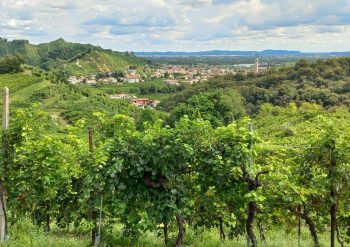
Among the most famous wines of Treviso area there is certainly Prosecco.
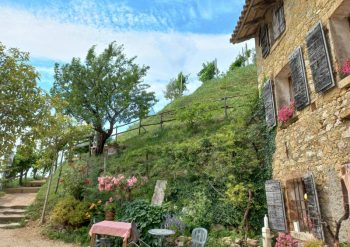
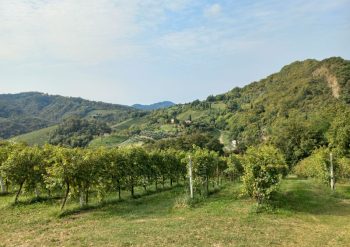
Visiting Prosecco Hills is an unforgettable experience of flavours, art and nature. Prosecco hills offer landscapes of authentic beauty, where signs of the rural, civil and religious history of the local people are visible. Among the most famous destinations are the enchanting villages of Valdobbiadene area such as San Pietro di Barbozza, Saccol, Santo Stefano, but equally evocative Soligo, San Pietro di Feletto and Premaor.



MARCA TREVIGIANA NATURALISTIC TREASURES
Of no less beauty are the naturalistic treasures of the Treviso area such as Montello, whose woods were once intensely protected and exploited by the Serenissima to supply the Arsenal and build the stilts on which the entire city is based. Montello was also the scene of the tragic events of the Great War and still today preserves monuments that commemorate those tragic events such as the King’s Observatory, the monument dedicated to Francesco Baracca and the Abbey of Sant’Eustachio, heavily damaged by bombing.
Other places to visit are the lakes such as those of Revine or Val Lapisina, and the naturalistic areas found along the course of the Piave river such as the Fontane Bianche Oasis in Sernaglia della Battaglia and Isola dei Morti in Moriago della Battaglia, as well called because, during the First World War, it was a disputed area in the center of the Piave front, which caused a large number of losses on the part of both armies.
Another wonder not to be missed, the enchanting Caglieron Caves in Breda di Fregona.
And have you ever been to Treviso area? Which place would you visit first?
You might also be interested in this article: Best day trips from Treviso
Always remember to bring sustainability in your suitcase, respect the environment and the community that hosts you!