

 Italiano
Blog, Prosecco Trail
THE GUIDE TO ORGANIZING THE PROSECCO TRAIL

Apr
Do you want to walk the Prosecco Trail?
Do you want to know what to visit in the UNESCO Prosecco Hills?
Do you want to find out which are the typical products not to be missed?
In this article you will find all the useful information to embark on the Prosecco Trail: the path with the various stages, the main places of interest, the food and wine delicacies to taste, how to prepare for this journey full of history, art, of nature, of ancient traditions and flavors.
Are you ready? Here are all the information you need.
Index:
The path of the Prosecco Trail
What to visit along the Prosecco Trail
What to visit around the Prosecco Trail
Things to do along the Prosecco Trail
Typical products to taste along the Prosecco Trail
Getting ready for the Prosecco Trail
THE PATH OF THE PROSECCO TRAIL
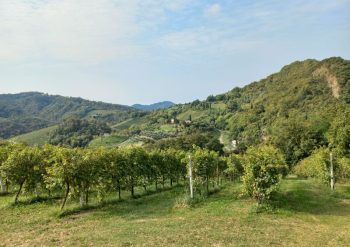
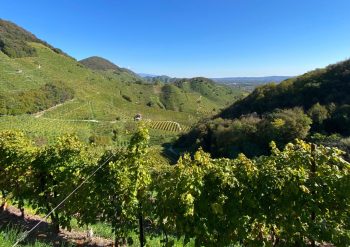
A path through a unique territory, 52 km of wonders to be discovered step by step among gentle hills, vineyards, farmhouses, lush woods, medieval churches and ancient routes. A path that allows you to enjoy landscapes of extraordinary beauty, to admire real artistic and naturalistic jewels and to retrace the signs left by history, in particular by the Great War.
The route, which begins in Vidor and ends in Vittorio Veneto, winding along the crest of the UNESCO hills, crosses, in addition to the places of departure and arrival, also Colbertaldo, the southern hills of Valdobbiadene, Col San Martino, the Vedette route of Farra di Soligo, Premaor di Miane, the Three Bridges of Follina, the area of Cison di Valmarino with Zuel di Qua and Zuel di Là, Arfanta, Tarzo, Nogarolo and Serravalle.
For a standard hiker, the path can be divided into four stages while the more trained can end it in two. The route has some more challenging sections, such as the final part of Monte Comun and Monte Baldo. For this reason there is a simpler northern variant that crosses the localities of Fratta, Colmaggiore and the southern part of Revine.
Travelers who embark on the Prosecco Trail receive a credential on which the stamps for each completed stage are affixed, as well as a final certificate.
A unique opportunity to visit the hills that are now a World Heritage Site, slowly, over several days, savoring the landscape step by step.
TRIPS ALONG THE PROSECCO TRAIL



WHAT TO VISIT ALONG THE PROSECCO TRAIL
The Prosecco Trail encompasses everything a hiker could wish for. It is an opportunity to immerse yourself in the infinite beauty of this pre-alpine area: from the gentle slopes embroidered by the vineyards, to the valleys rich in crystal clear waters, to the sharp ridges of the hills. In addition to this, a lot of art and culture that originates from centuries of history, the traces of which are still visible in the numerous villages, abbeys, castles, churches and popular traditions.
Here’s what to visit along the Prosecco Trail.


VIDOR
The itinerary begins in Vidor, in the heart of the Marca Trevigiana, on a hill that rises near the Piave river.
In addition to the characteristic historic center, the village preserves the Abbey of Santa Bona, built in the 11th century and rebuilt after the damage suffered during the First World War. The Church dedicated to the Holy Name of Mary, built in the 18th century, stands on the remains of a previous religious building and has undergone a radical restoration after the Great War. Do not miss the Sanctuary of the Madonna delle Grazie in Colbertaldo, an ancient building dating back to the fourteenth century which is a frequent destination for pilgrimages.
VALDOBBIADENE
The Prosecco Trail from Vidor continues towards the southern hills of Valdobbiadene. These places tell of enormous efforts but also of great satisfactions. Today, in fact, this territory is an important district from the enological point of view for the production of one of the most known and appreciated wines in the world, Prosecco.
The itinerary crosses landscapes of authentic beauty, marked by the rural, civil and religious history of the local people. The story of men and women who in their daily behavior have marked the passage of time and modulated everyday life.
Here lies the Cartizze area, 107 hectares of vineyards among the steepest hills of San Pietro di Barbozza, Santo Stefano and Saccol, which gives rise to a unique wine, born from the perfect combination of a sweet very ancient land, generated by the raising of the seabed.
In San Pietro di Barbozza, a room of the Brunoro house, frescoed with Bacchic motifs, is the headquarters of the Confraternity of Valdobbiadene. A little further on, on the top of Col Croset, you can still admire the remains of the Mondeserto castle, dating back to around the twelfth century. Not far away is one of the oldest places of worship in Valdobbiadene, the millenary rural church of San Biagio di Stana, the holy miracle worker who protects against throat diseases.
Continuing north, the Monte Cesen area appears majestic, an area of great interest from a naturalistic and ethnographic point of view. Here it is a must to stop in one of the characteristic mountain cottage to savor the tasty typical mountain products.


COL SAN MARTINO AND FARRA DI SOLIGO
Step by step you reach the Vedette path, which winds through the Prosecco hills from Col San Martino to Soligo. The itinerary is so called because during the Great War it was a checkpoint of the Austro-Hungarian army: from the top of these hills you could have a perfect view over the entire front line along the Piave river. A place therefore of great strategic importance, testified by the numerous tunnels and trenches that can still be observed along the route.
MIANE
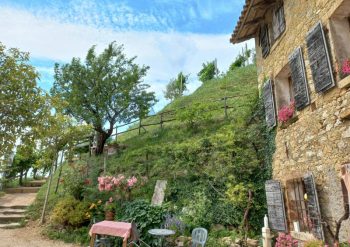
The Prosecco Trail continues along the hills of Premaor di Miane, covered with vineyards dotted with numerous ancient farmhouses. This landscape, unique of its kind, is evidence of a seasonal agricultural activity practiced by families who moved from neighboring towns in the summer. A leap into the past, when time was marked by the slow flow of days and the economy was mainly linked to the breeding and the cultivation of vines.


FOLLINA, ZUEL DI QUA AND ZUEL DI LA’
The itinerary then enters the hills of Follina, a village known for the wonderful Cistercian Abbey of Santa Maria, one of the most renowned and beautiful complexes of great artistic value in the region. The origin of the toponym is linked to the presence of the monks of the abbey. They, in fact, brought and developed the “fulling” activity in this area.
Follina is one of the “Most Beautiful Villages of Italy” together with the nearby village of Cison di Valmarino, whose territory is crossed by the Prosecco Trail near Zuel di Qua and Zuel di Là, two places with a curious name hidden in the bush of ridge, which have about fifty inhabitants in all.
The term Zuel derives from the Latin “iugum” or yoke or pass among the mountains. The division between “di Qua” and “di Là” instead derives from the fact that the road that connects Gai to Rolle separates the two halves.
Along the path you will encounter splendid centuries-old chestnut trees and picturesque rural churches dedicated to Santa Eurosia and Santa Lucia, places of great faith and devotion.
TARZO
The Prosecco Trail then crosses the villages of Arfanta, Tarzo and Nogarolo.
Here to avoid the most demanding stretches, it is possible to follow the northern variant that continues to Fratta, Colmaggiore and the southern part of Revine, offering a simpler solution.
Among the picturesque streets of Tarzo, Fratta and Colmaggiore, you can embark on a real journey through time, discovering the stories of everyday life of the past thanks to the famous murals painted by different Venetian artists. These works tell, with a simple and direct language, popular traditions, history and local folklore in a truly fascinating way.
The path then skirts the two lakes of Santa Maria and San Giorgio between the towns of Revine Lago and Tarzo. Frequented since the Neolithic, they are the remnant of a larger lake formed by one of the branches of the Piave glacier during the various phases of the last glaciations. They constitute an important naturalistic site with numerous marshy areas and extensive peat swamps. These lake basins are the subject of various mysteries and legends such as the one about the alleged locomotive sank by the Austrians in 1918.


VITTORIO VENETO
The Prosecco Trail ends in Vittorio Veneto, passing through Serravalle, one of the most important centers of the Serenissima on the mainland, characterized by ancient streets and squares, by Venetian-style buildings, and by the “Meschietti”, a 16th-century hydraulic engineering work. From the historic center you can reach the suggestive Sanctuary of Sant’Augusta, the emblem of the city.
But Vittorio Veneto is also known for the facts related to the Great War. Here between 24th October and 4th November 1918 the final battle was fought, the last armed clash between Italy and the Austro-Hungarian Empire.
WHAT TO VISIT NEAR THE PROSECCO TRAIL
In addition to the wonders encountered along the Prosecco Trail, there are numerous other artistic, architectural and naturalistic jewels kept among the gentle slopes of these hills. So why not take advantage of it? With short detours you can visit some truly magical places.
Here’s what to see around the Prosecco Trail.
We start from Segusino and the picturesque villages of Stramare and Miliès, reachable along enchanting paths that wind through woods, crystalline streams and meadows.


Do not miss Montello, a singular hill in the shape of a tortoise that rises, isolated and well defined, south of the course of the Piave river. At one time the ecosystem, mainly oak wood, was strictly bound by the laws of the Republic of Venice as the “Bosco della Serenissima” was used for the timber of the Venetian shipyards.
Numerous testimonies of the past are still visible here today. In fact, the most important moments of the Great War after the defeat of Caporetto took place on Montello: from the decisive resistance against the Austro-Hungarian to the Solstice and the final offensive, which decreed the end of the conflict and the victory of the Kingdom of Italy.
Another place to visit is the “Strada della fan” in Combai, an itinerary of high naturalistic and historical value since it refers to a sad but interesting chapter of the Great War. It is, in fact, a road built by the inhabitants of the area with compulsory work during the Austrian occupation.
Another place linked to the tragic events of the First World War is the San Boldo Pass, also called the “Road of 100 days”, because it was built from 1st February to 1st June 1918 by the will of the Austrian army. One hundred days of work, the broken backs of the Russian prisoners and the women of Tovena to build this engineering miracle with the tunnels dug into the rock with the rudimentary means of the time.
This spectacular pass that connects the province of Treviso and that of Belluno, for centuries a place of passage for men and goods, rises in Cison di Valmarino.
Starting from the historic center of the village it is possible to walk along the Mills Route which, entering the woods, leads to the discovery of the artisan reality of Cison until the beginning of the last century, linked to the Rujo stream and the exploitation of its waters as evidenced by old reconstructed wash houses, fountains, channels with several locks and ancient mills.


One of the most fascinating places in the UNESCO Prosecco Hills is undoubtedly the Molinetto della Croda, a 17th century rural building built on the rock, whose wheel was moved by the waters of the Lierza stream.
Among the natural wonders, the Val Trippera certainly deserves a visit, crossed by a suggestive path that winds through woods, caves and a multitude of ferns, the Val Lapisina where there are the blue springs of the Meschio, and the Caves of Caglieron, a truly peculiar environment consisting of a series of large potholes, waterfalls and caves that have formed over time thanks to the work of nature and man.
THINGS TO DO ALONG THE PROSECCO TRAIL
There are many opportunities to discover the UNESCO Prosecco Hills at 360 degrees. From numerous excursions on foot, by bike or on horseback, to tastings of typical products in the restaurants and wineries of the area, from visits to artisan shops and farms to open-air activities in the name of complete relaxation such as yoga, forest bathing, barefoot or tree hugging.
Do you want to go on a private excursion, be led by our Hiking Guides or participate in one of the activities that we regularly organize along the Prosecco Trail? Click here to discover our proposals and scheduled initiatives.
TYPICAL PRODUCTS TO TASTE ALONG THE PROSECCO TRAIL
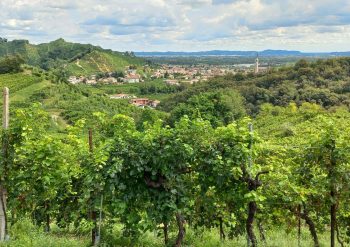
Among the specialties of the area absolutely to be tasted, we cannot fail to mention the wine that gives its name to this path: the Prosecco.
The origin of Prosecco is very ancient and its grape variety, Glera, was already used by the Romans to produce a particular white wine called “Pucino”. Prosecco-Glera as we know it today, on the other hand, has only been produced since the early twentieth century.
However, not everyone knows the ancestor of this excellence of Italian enology, namely Prosecco Colfondo. In fact, in the nineteenth century the farmers made a product for family use made from a still wine which was left with a certain sugar residue so as to allow, once bottled, a natural refermentation on its own yeasts. In this way a sparkling wine was obtained which left a natural residue of exhausted yeasts on the bottom of the bottle, hence the name “Col fondo”.
But Prosecco is not the only wine specialty of the UNESCO Hills. Among the other wines produced in this area we remember the Marzemino Passito di Refrontolo, also praised by Mozart, the Verdiso and the Torchiato di Fregona.
And with a good glass of wine, why not combine a tasty local cheese? There is plenty of choice between the unique Grotta cheese, the “Formajele trevigiane”, the numerous Latteria, whose birth is contemporary with the emergence of shift dairies and the delicious “Imbriago” cheese, son, apparently, of the First World War.
But the delights don’t end there. Among the typical products not to be missed we remember the “Fasol de Lago”, the “Figo Longhet de Tarz” and, in autumn, the famous “Marroni di Combai”.

GETTING READY FOR THE PROSECCO TRAIL
PHYSICAL TRAINING
The Prosecco Trail, 52 km long, has a medium technical difficulty, with a considerable altitude. For a standard walker the route can be completed in four stages while the more trained can complete it in two.
It is a path potentially within everyone’s reach, although the specific difficulties of each stage must be considered. The aspects to be evaluated most are the length, the difference in height, the absence of water sources, heat in the central hours of the day.
Especially for those who are totally out of practice, to increase endurance, it is advisable to take a few walks before departure.
EQUIPMENT
To walk the Prosecco Trail with peace of mind and safety, it is important to have adequate equipment. Here are some useful tips.
Clothing must be essential and always suitable for the season. We suggest wearing non-bulky and breathable clothing, dressing “in layers”.
We recommend that you choose appropriate hiking shoes, which must be of good quality and have good grip. Trekking poles can be especially useful in some places. We suggest you have a map, compass and GPS as well as a spare battery or an external auxiliary battery.
The backpack cannot miss a water bottle, a hot drink if in winter, a kway suitable for the period, a thermal blanket, a hat or cap, a knife, glasses, a protective cream, a mini first aid kit, a headlamp and possibly spare clothing according to weather conditions.
Once the backpack is ready, abandon yourself to the slow rhythms of nature and rural life, enjoy, step by step, this unique experience, remembering to leave only a light imprint … That of the hiking shoes.
You may also be interested in these articles:
Places to visit the Prosecco Trail
Things to do along the Prosecco Trail
TRIPS AND HIKES ALONG THE PROSECCO TRAIL
Discover the tours and hikes we organize along the Prosecco Trail and its surroundings.
FIND OUT MORE