

 Italiano
Blog, Prosecco Trail
PLACES TO VISIT ALONG THE PROSECCO TRAIL

Apr
Places to visit along the Prosecco Trail: here is our guide.
Walking the Prosecco Trail is an experience that offers unique emotions. A 52 km journey through breathtaking landscapes: hills embroidered with vineyards, characteristic farmhouses, splendid abbeys, picturesque country churches, luxuriant woods and enchanting villages.
If you are about to walk along this path among the UNESCO Prosecco Hills, then this article is just for you.
TRIPS ALONG THE PROSECCO TRAIL

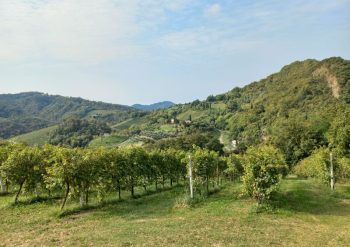
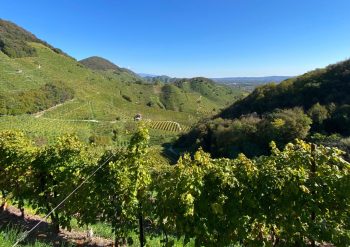


Here are the places to visit along the Prosecco Trail.
Indice:
VIDOR
The Prosecco Trail begins in Vidor, a pretty village nestled on a hill near the Piave river.


The Archpriest Church dedicated to the Santissimo Nome di Maria probably dating back to the early year 1000, between 1729 and 1748 was rebuilt at the foot of the castle hill. It suffered serious damage during the First World War, when the town, being right at the front of the Piave, was chosen to make a “bridgehead” in order to allow the crossing of the river by the Italian troops in retreat from the defeat of Caporetto.
At the site where the castle of Vidor once stood, destroyed in the sixteenth century, stands the Oratory of the Addolorata, a monument-ossuary that commemorates the soldiers who fell during the world wars.
In Vidor there is also the enchanting Abbey of Santa Bona, founded between 1107 and 1110 by Giovanni Gravone to preserve the relics of the Saint that he moved from the Holy Land during the first crusade.
In Colbertaldo there is the Sanctuary of the Madonna delle Grazie, built in the fifteenth century, after the arrival of the servants of Mary from the convent of Santa Caterina di Treviso.
VALDOBBIADENE
The path then continues towards Valdobbiadene.
Immersed in the famous UNESCO Hills, Valdobbiadene is the “Capital of Prosecco Superiore” and has a lot to offer to visitors also from a historical, artistic and naturalistic point of view.
Here, in addition to the eighteenth-century Cathedral of Santa Maria Assunta, built on the spot where a place of worship stood as early as 1297, there are numerous Venetian villas, such as Villa Morona De Gastaldis, Villa Piva called dei Cedri and Villa Barberina Arten Viansson.
Between the hills of San Pietro di Barbozza, Santo Stefano and Saccol, stands the Cartizze area, a small region of 107 hectares of vineyards that gives rise to a unique wine, born from the perfect union between a sweet microclimate and an ancient soil, generated from the lifting of the seabed.
In San Pietro di Barbozza the wine cell of the Brunoro house houses the headquarters of the Confraternity of Valdobbiadene, an authentic Prosecco university, founded in1945.
On the Col Crosét, which overlooks the town of Saccol, the castle of Mondeserto stood in medieval times, one of the major defensive structures in the Valdobbiadene area. Today only a few portions of the perimeter wall remain of this fort.


Continuing our journey, in Bigolino stands the Church of San Michele, whose title, although the current structure is from the nineteenth century, suggests an ancient origin, referable to the Lombard period.
Another curious place of worship is the Oratory of the Madonna della Rosa whose construction would be linked, according to tradition, to the discovery on the Piave bed, in time immemorial, of a wooden statue depicting a Madonna and Child, both with a rose in hand.
In Bigolino there is also the Settolo Basso area, of great naturalistic value, characterized by the presence of humid environments, ideal habitats for various species of birds.
Overlooking Valdobbiadene the mighty profile of Monte Cesen, reachable by trekking enthusiasts via Strada de le Musse, once crossed by cargo sledges to transport various materials, such as wood,stone and hay. The Monte Cesen is a area of great naturalistic and ethnographic interest as well as offering numerous possibilities for lovers of good food. Here, in fact, there are characteristic mountain cottages where you can taste delicious typical products.
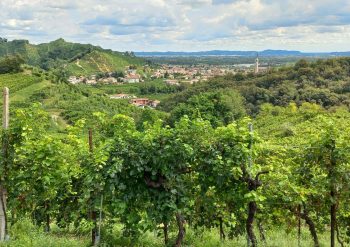
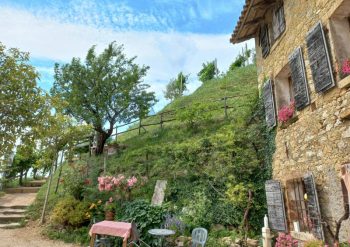


Food and wine tours
FARRA DI SOLIGO
Step by step you reach the Vedette path, an itinerary that winds through the Prosecco Hills from Col San Martino to Soligo. Along the way you can observe numerous tunnels and trenches as, during the Great War, this area was a checkpoint of the Austro-Hungarian army: from the top of these hills it was possible to control the front line along the Piave river.
In Farra di Soligo, in the ancient village of Collagù, you can admire the Sanctuary dedicated to the Beata Vergine Addolorata, built on a vow of the noble Bottari de Castello family in 1932. Another place not to be missed, the Credazzo Towers, three towers connected by an original wall of the IX-X century.

At Col San Martino stands the Church of San Vigilio, built around 1100 on the top of a hill, perhaps the site of a previous fortress.
In Soligo there is the Church of Saints Peter and Paul, whose first attestation is dated 3rd February 1212 with the mention of the “portico of the church of San Pietro di Soligo”. No trace remains of that ancient building as it was radically rearranged starting in 1720 and remodeled during the twentieth century.
In Soligo, on the top of the homonymous hill, stands a small jewel, the Hermitage of San Gallo. The first attestation of the structure dates back to 1354 and was already then identified as the “Sancti Galli de Solico” church and inhabited by some hermits. In the past, the place was a destination for pilgrims who suffered from insomnia.
MIANE
The Prosecco Trail continues along the hills of Premaor di Miane. Here the landscape is unique in its kind, as it testifies to a seasonal agricultural activity, based on the breeding and the cultivation of vines, practiced by the families of the area who moved from neighboring towns in the summer.

In this area, Prosecco is not the only wine produced. Here Verdiso is grown, a native vine of the Treviso foothills whose plant was imposed on the settlers of the Abbey of Follina as early as 1788.
Among the other typical products of the area, the famous “Marrone di Combai IGP” to which a festival is dedicated in the autumn period.
In Combai, the “Strada de la fan” winds through the woods among majestic chestnut trees, built by the inhabitants of the area, with compulsory work, during the First World War in the period of Austrian occupation.
FOLLINA, ZUEL DI QUA E ZUEL DI LA’
The itinerary then enters the hills of Follina, a village known for the enchanting Cistercian Abbey of Santa Maria. It was the monks of this religious complex who introduced and developed the “fulling” activity in this area, from which the toponym derives. The abbey is mentioned for the first time in a document dated 1127, attesting to the sale by the Abbot Bernardo to a certain Arpone of three fields.
The source of Santa Scolastica gushes out in the historic center, from which the very short river Follina originates. The waterways in the past have had a certain importance as they moved the wheels of mills and hammers that dotted the area. For example, the Fiadora, a tributary of the Follina, in addition to supplying the Abbey of Santa Maria, once was used by some mills.

The Prosecco Trail continues towards Zuel di Qua and Zuel di Là in the municipality of Cison di Valmarino. The term “Zuel” derives from the Latin “iugum”, pass between the mountains. Along the path you can admire majestic centuries-old chestnut trees and the characteristic rural churches of Santa Lucia and Santa Eurosia. This one was built in 1764 by the Brandolini family, who administered this territory for centuries.
In the village of Cison di Valmarino stands what was the residence of this powerful family, Castelbrando, erected in Roman times as a military post with control and defense functions, probably of a secondary branch of the Via Claudia Augusta.
From the historic center, along a path that goes into the woods, you can take a real leap in time, to discover what was the artisan reality of Cison di Valmarino until the early twentieth century, linked to the Rujo stream and to exploitation of its waters.

Not to be missed in the surroundings of Cison di Valmarino is the spectacular San Boldo Pass, also known as the “Road of the Hundred Days”, an Austrian engineering work for war purposes traced on a Roman route and which still retains a Byzantine tower.
Another place to visit in the surroundings of Cison di Valmarino is Rolle, a pleasant rural village nestled between the Prosecco Hills, defined by the poet Andrea Zanzotto, “A postcard sent by the Gods”. Here stands the Church of Santi Giacomo e Filippo, a structure of very ancient origin, whose current forms are due to the restructuring works of the 18th century.
Do not miss Gai and the small church dedicated to San Michele Arcangelo which stands out on the top of a hill, a natural terrace on the Valmareno. The building dates back to 1740, but several documents attest to its existence as early as the thirteenth century.
TARZO
The Prosecco Trail then crosses the towns of Arfanta, Tarzo and Nogarolo.
At this point, to avoid one of the most demanding stretches, it is possible to follow the northern variant that continues through the villages of Fratta, Colmaggiore and the southern part of Revine, offering a simpler solution.
Arfanta houses the Church of San Bartolomeo Apostolo, the oldest parts of which date back to the fifteenth century.
Nogarolo is a very picturesque village due to the presence of typical architecture with arcades and fountains. The bell and an altarpiece of the small oratory of the town would come from the disappeared villa of Bellostare, residence of the scholar Toldo Costantini.


Do not miss the Via dei Murales, among the streets of Fratta and Colmaggiore. Here the walls of the houses have been decorated with artworks that represent traditions and old crafts that have now disappeared, evoking the stories of daily life of the inhabitants of these areas in the past centuries.
Worthy of note is the ancient church of San Martino in Fratta, with frescoes dating back to the 13th century.
The path then skirts an area of great naturalistic value, the lakes of Santa Maria and San Giorgio. The origin of the two lake basins is a consequence of the events of the last ice age when the Piave glacier began to retreat.
VITTORIO VENETO
The Prosecco Trail ends in Vittorio Veneto, a city rich in art, history and nature. This city was born from the union of what were once two distinct localities, Cèneda and Serravalle.
Vittorio Veneto is also known for the facts related to the Great War. Here between 24th October and 4th November 1918 the final battle was fought, the last armed clash between Italy and the Austro-Hungarian Empire during the First World War.
The symbol of the city is the Sanctuary of Santa Augusta, built in 1450 to house the remains of the Saint. From here the view is truly impressive.
Do not miss the Cathedral of Santa Maria Assunta e San Tiziano Vescovo, the main cult building of the diocese of Vittorio Veneto, of very ancient origins. A small church probably existed on the site even before the arrival of the body of San Tiziano di Oderzo (VII-VIII century). The current appearance in neoclassical style dates back to the mid-eighteenth century.
From the profile of the city stands the silhouette of the Castle of San Martino founded in the Lombard period and renovated in different periods. The castle has been a bishop’s residence since the end of the 10th century.
Vittorio Veneto is crossed by the Meschio river. Serravalle, built along its course, was a renowned center for gunsmith production during the Middle Ages which used the river waters to harden the blades. The source of the Meschio is located in Savassa.


Val Lapisina, near Vittorio Veneto, offers the opportunity to enjoy apparently humble, but in reality extraordinary, spectacles of nature and beyond: the enchanting villages perched on the mountains, the Lago Morto, and the suggestive Lago di Negrisiola and del Restello, on whose waters the imposing San Floriano Tower is reflected.
Here ends our journey to discover an extraordinary land, that of the UNESCO Prosecco Hills. A path that winds through vineyards, farmhouses, ancient places of worship, old mills, forts, crossing spectacular landscapes, engraved over the centuries by nature and with a pen led by the hand of man.
You may also be interested in these articles:
The guide to organizing the Prosecco Trail
Things to do along the Prosecco Trail
TOURS AND HIKES ALONG THE PROSECCO TRAIL
Discover the tours and hikes we organize along the Prosecco Trail and its surroundings.
FIND OUT MORE